

Getting Answers About Your Care
Preparing for your pain management treatments doesn’t have to be overwhelming. The resources below provide quick details on clinic policies, appointment preparation, and what you can expect from our team.
Frequently Asked Questions
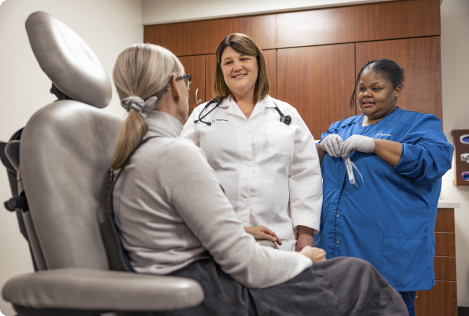
A pain center multidisciplinary team addresses your chronic pain and develops a treatment plan.
Ask your primary care or specialty doctor for a referral to pain management. They can send a referral through EPIC or fax 517-364-5335.
Please visit Financial Services to check on your insurance. We have a dedicated financial counselor to process pre-authorizations and help you through this process.
Our goal is to reduce pain, restore function, and help you get back to your daily activities. While every patient's experience is different, many people find significant relief and an improved quality of life due to treatment.
Pain Counselors use a variety of techniques to help patients manage the psychological and emotional burden of persistent pain, including depression, anxiety and grief over lost function. They utilize evidence-based strategies to help retrain the brain's response and reduce nervous system overactivity.
Additionally, a Master of Social Work (MSW) can address social factors—such as work stress, financial strain, and relationship dynamics-to support overall quality of life and functional recovery.
No, during the initial consultation you will work with a care team- a medical assistant, nurse practitioner and physician to develop your own individualized comprehensive plan.
Scheduling injections if they are part of your plan can done by you and the front desk team before you leave your consultation.
Every person's pain journey is different. You will work with the multi-disciplinary team to ensure you receive the best care for you and your pain.
Normally the actual procedure takes around 15 minutes for an injection procedure and 45 minutes for a rhizotomy.
Please plan on 1 to 1 1/2 hours. This includes pre-procedure intake all the way through to recovery after the procedure.
Many procedures can be completed without sedation. Our team uses relaxation and distraction techniques to help make your experience as comfortable as possible.
When appropriate, conscious sedation is available. This medication helps you relax and decreases awareness while keeping you awake and able to respond.
Depending on the specific procedure, procedures can include injection with a local anesthetic and steroid. Specific details, including the planned substances for injection, are discussed prior to scheduling any procedures.
Depending on the specific procedure, X-rays (C-arm fluoroscopy) may be used to help the physician place the needle close to the appropriate nerves. Specific details, including the use of X-rays, are discussed prior to scheduling any procedures.
Generally, you should avoid strenuous activity after a pain management procedure, but specific activity restrictions depend on the actual procedure.
Fortunately, direct injury to nerves from the injection or by infection is rare and estimated at about a one in 50,000 chance depending on the procedure.
You may not have any noticeable side effects from the procedure. Occasionally a patient may experience some of the following side effects:
- Tenderness and/or aching at the site of the injection site.
- Bleeding or bruising at the injection site.
- Numbness or weakness of arms or legs for a few hours.
Following your procedure, you will be given a list of potential side effects based on your health conditions and the specific procedure that you had.
Our goal is to find the source of your pain and reduce your need for medication. The multidisciplinary team creates an individualized treatment plan for each patient using a variety of therapies and interventions.
If medication is needed and appropriate, a pain counselor evaluation is required before any controlled substance can be prescribed.