

Overview
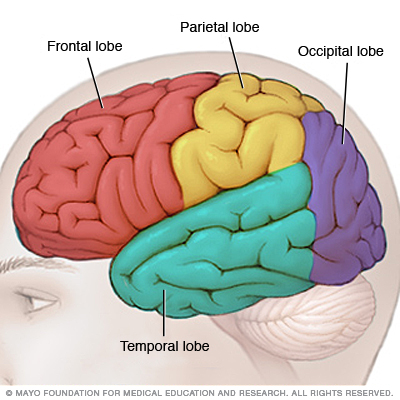
Frontal lobe seizures are a common form of epilepsy. Epilepsy is a brain condition in which clusters of brain cells send a burst of electrical signals. These electrical signals cause movements that can't be controlled. These movements are called seizures. Frontal lobe seizures begin in the front of the brain, the area known as the frontal lobe. The frontal lobe is one of the largest areas of the brain and helps with many important tasks, including movement. Frontal lobe seizures also are known as frontal lobe epilepsy.
Frontal lobe seizures can produce symptoms such as laughing or screaming that can't be controlled. The symptoms may appear to be related to a mental illness. The seizures also can be mistaken for a sleep disorder because they often happen during sleep.
Changes in brain tissue, infection, injury, stroke, tumors or other conditions can cause frontal lobe seizures.
Medicine can help manage the seizures. Surgery or electrical stimulation might be options if medicine doesn't stop or reduce the number of seizures.
Symptoms
Frontal lobe seizures often last less than 30 seconds. Sometimes recovery is immediate.
Symptoms of frontal lobe seizures might include:
- Head and eye movement to one side.
- Not responding to others or having trouble speaking.
- Explosive screams, including profanities or laughter.
- Changing the body's posture, such as extending one arm while the other flexes as if the person is posing like a fencer.
- Repetitive movements such as rocking, bicycle pedaling or pelvic thrusting.
When to see a doctor
See a healthcare professional if you're having symptoms of a seizure. Call 911 or emergency medical help if you see someone having a seizure that lasts longer than five minutes.
Causes
Frontal lobe seizures can be caused by tumors, stroke, infection or traumatic injuries in the brain's frontal lobes.
Frontal lobe seizures also are associated with a rare inherited form of epilepsy called autosomal dominant nocturnal frontal lobe epilepsy. This form of epilepsy causes brief seizures during sleep. If a parent has this form of epilepsy, there is a 50% chance the child will have it too.
The cause is not known for about half the people who have frontal lobe epilepsy.
Risk factors
Risk factors of frontal lobe seizures include:
- Family history of seizures or brain conditions.
- Head injury.
- Brain infection.
- Brain tumors.
- Blood vessels or brain tissues that don't form in the typical way.
- Stroke.
Complications
Frontal lobe seizures can cause complications that may include:
- Seizures that last dangerously long. Frontal lobe seizures tend to happen in clusters. For this reason, they might provoke a condition in which seizure activity lasts much longer than usual, known as status epilepticus. If these seizures continue, they can cause permanent brain damage or death. Seizures that last longer than five minutes are medical emergencies. Call 911 or get medical help right away if you witness someone having a seizure for longer than five minutes.
- Injury. The uncontrolled motions that happen during frontal lobe seizures sometimes result in injury to the person having the seizure. Seizures also may result in accidents and drowning, such as while driving or swimming.
- Sudden unexplained death in epilepsy (SUDEP). People who have seizures have a greater risk than the average person of dying suddenly. The reasons for this are not known. Possible factors include heart or breathing issues, perhaps related to genetic changes. Managing seizures with medicines appears to be the best way to prevent SUDEP.
- Depression and anxiety. Both are common in people with epilepsy. Children also have a higher risk of attention-deficit/hyperactivity disorder (ADHD).
Diagnosis
Frontal lobe epilepsy can be hard to diagnose. Its symptoms can be mistaken for mental health conditions or sleep disorders, such as night terrors. It also is possible that some symptoms of frontal lobe seizures are the result of seizures that begin in other parts of the brain.
To make a diagnosis, a healthcare professional reviews your symptoms and medical history. You may have a physical exam and blood tests to check for other health conditions that could be causing the seizures.
You might need a neurological exam to test your:
- Muscle strength.
- Sensory skills.
- Hearing and speech.
- Vision.
- Coordination and balance.
Several scans and imaging tests can help diagnose frontal lobe seizures:
-
An electroencephalogram (EEG) monitors the electrical activity in the brain. This is done by attaching small metal disks called electrodes to the scalp. EEGs often help diagnose some types of epilepsy, but they may not identify frontal lobe epilepsy.
Video monitoring may be used along with EEG. This is usually done during an overnight stay at a sleep clinic. A video camera and an EEG monitor you through the night. A video EEG allows healthcare professionals to match what physically happens during a seizure with what appears on the EEG.
- CT and MRI scans look for physical issues in the brain that can cause seizures, such as tumors and cysts. A functional MRI (fMRI) shows if there are issues with how different areas of the brain are working.
- Positron emission tomography (PET) scans show chemical activity and metabolism levels in the brain, which can help identify where a seizure started and ended.
Treatment
Over the past decade, treatment options have increased for frontal lobe seizures. There are several types of medicines to treat seizures. There also are a variety of surgical procedures that may help if medicines don't work.
Medications
Most antiseizure medicines work equally well at controlling frontal lobe seizures. But not everyone becomes seizure-free on medicine. You may need to try different medicines. Or you may need to take a combination of medicines to manage your seizures. Researchers continue to look for new and more effective medicines.
Surgery
If medicine does not control your seizures, surgery might be an option. Before surgery, the goal is to find the areas of the brain where your seizures happen.
Imaging tests can help identify the area that causes the seizure. Tests may include:
- Single-photon emission computerized tomography (SPECT). SPECT uses a tracer to find where the seizure starts in the brain. A tracer is a contrast material injected into the blood that shows blood flow during a seizure. Scans are done during and after the seizure, then compared. The seizure area has higher blood flow. This test may require an overnight stay.
- Stereoelectroencephalography (SEEG or stereo EEG). With SEEG, electrodes are surgically implanted into the brain where the seizures are happening. SEEG can help determine if an individual is a candidate for epilepsy surgery.
- Brain mapping. Brain mapping is commonly used before epilepsy surgery. Brain mapping involves implanting electrodes into an area of the brain. Then electrical stimulation is used to determine whether that area has an important function. This helps to rule out surgery on certain areas of the brain. Functional MRI (fMRI) is used to map the brain's language area.
If you have surgery for frontal lobe seizures, it's likely you'll still need antiseizure medicine after the surgery. But surgery may allow you to take a lower dose.
Surgery for epilepsy might involve:
- Removing the focal point. If your seizures always begin in one spot in your brain, this spot is called the focal point. You may have surgery to remove that small area of brain tissue. This might reduce the number of seizures you have. Or it might stop your seizures.
- Isolating the focal point. Sometimes, the area of the brain that causes seizures is too vital to remove. When this happens, surgeons might make a series of cuts to help isolate that section of the brain. This prevents seizures from moving into other parts of the brain.
- Vagus nerve stimulation (VNS). This procedure involves implanting a device similar to a cardiac pacemaker under the skin of the chest. The device sends pulses that stimulate the vagus nerve. This procedure usually lowers the number of seizures.
- Deep brain stimulation (DBS). This procedure involves making small holes in the skull to implant the electrodes into brain tissue. The electrode is connected to a pacemakerlike stimulating device under the skin of the chest. The device sends signals to the electrode in the brain to stop the activity that triggers a seizure.
- Responsive neurostimulation (RNS). This procedure involves implanting an electrode into the brain where the seizures likely start. It is placed within the bones of the skull and hidden under muscles and hair. The electrode is connected to an EEG device. The device detects the start of a seizure and then delivers a signal to that area of the brain to stop the seizure.

Alternative medicine
Some people with neurological conditions, including seizures, turn to complementary and alternative medicine, such as:
- Herbs.
- Acupuncture.
- Psychotherapy.
- Mind-body techniques.
- Homeopathy.
Researchers are looking into these therapies to determine their safety and effectiveness. However, strong evidence that they effectively reduce seizures is limited. There is some evidence that a ketogenic diet might be effective for treating seizures, particularly in children. A ketogenic diet is a strict high-fat, low-carbohydrate diet.
People often use herbs to try to reduce their seizures. But there's not much evidence that herbs are effective. Some herbs can cause an increased risk of seizures.
Marijuana, also known as cannabis, is one of the most commonly used herbs for treating epilepsy. The U.S. Food and Drug Administration has approved Epidiolex, a medicine that contains the purified marijuana chemical cannabidiol (CBD). The medicine was approved to treat two rare forms of severe childhood epilepsy: Dravet syndrome and Lennox-Gastaut syndrome. Epidiolex also was approved to treat seizures caused by tuberous sclerosis complex, a rare condition where tumors that are not cancer grow on the brain. CBD hasn't been approved for any other type of epilepsy.
Researchers are studying how effective CBD may be for treating other types of seizures. They're also studying its potential risks, including how CBD interacts with antiseizure medicines. Cannabis products have been reported to make seizures worse.
The FDA doesn't currently regulate herbal products. Herbs can interact with antiseizure medicines, putting your health at risk. Talk to a healthcare professional before taking herbal or dietary supplements for your seizures.
Lifestyle and home remedies
You may find that certain things trigger seizures. Seizures can be triggered by alcohol intake, smoking and, especially, lack of sleep. There also is evidence that severe stress can provoke seizures and that seizures themselves can cause stress. Avoiding these triggers when possible might help improve seizure control.
Coping and support
Some people who have epilepsy are frustrated by their condition. Frontal lobe seizures can involve loud utterances or body movements that may make the person with epilepsy anxious.
Parents of children with frontal lobe seizures can find information, resources and emotional connections from support groups. Support groups also can help children who have epilepsy. Counseling can be very helpful. Adults with epilepsy can find support through in-person and online groups.
Preparing for an appointment
You're likely to see a primary healthcare professional first. This person may refer you to a healthcare professional in nervous system conditions, called a neurologist.
What you can do
Ask a family member or friend to come with you to the appointment to help you remember the information you receive.
Make a list of:
- Your symptoms. Include even those that seem unrelated to the reason you scheduled the appointment, when they began and how often they happen.
- All medicines, vitamins and supplements you take, including doses.
- Questions to ask the healthcare professional.
Some questions to ask include:
- What is likely causing my symptoms or condition?
- Will I likely have more seizures? Will I have different types of seizures?
- What tests do I need? Do they require any special preparation?
- What treatments are available, and which do you recommend?
- I have other medical concerns. How can I manage them together?
- Is surgery a possibility?
- Will I have restrictions on my activity? Will I be able to drive?
- Are there brochures or other printed materials I can have? What websites do you recommend?
What to expect from your doctor
You're likely to be asked questions, such as:
- Did you notice any unusual sensations before the seizures?
- How often do the seizures happen?
- Can you describe a typical seizure?
- How long do the seizures last?
- Do the seizures happen in clusters?
- Do they all look the same or are there different seizure behaviors you or others have seen?
- Have you noticed seizure triggers, such as illness or lack of sleep?
- Has anyone in your immediate family ever had seizures?
© 1998-2026 Mayo Foundation for Medical Education and Research (MFMER). All rights reserved. Terms of Use