


Overview
Meniere's disease is a rare condition of the inner ear that causes dizzy spells, called vertigo. The disease also may lead to hearing loss. It often causes ringing, buzzing or roaring in the ear, called tinnitus. And it can cause feelings of fullness or pressure in the ear. Meniere's disease typically affects just one ear.
These symptoms may come and go. They typically start without warning and then go away. This cycle happens over and over. Over time, hearing loss and balance may get worse.
Meniere's disease can start at any age. But typically it begins between ages 40 and 60. It's considered to be a lifelong condition, but treatments can help manage symptoms. The right treatment may lessen how Meniere's disease affects your daily life.
Symptoms
People with Meniere's disease typically have a combination of symptoms that affect hearing and balance. These may include:
- Dizzy spells, called vertigo. You may have a spinning feeling that starts and stops suddenly. Vertigo may start without warning. It usually lasts 20 minutes to 12 hours. Vertigo rarely lasts more than 24 hours. Serious vertigo can cause nausea. After an episode of vertigo, symptoms typically get better and may go away for a while. Over time, the number of vertigo attacks you have may lessen.
- Hearing loss. Hearing loss in Meniere's disease may come and go, especially early on. Over time, hearing loss may not get better, even with treatment.
- Ringing in the ear. Tinnitus is the medical term for when you have a ringing, buzzing, roaring, whistling or hissing sound in your ear.
- Feeling of fullness in the ear. People with Meniere's disease often feel pressure in the ear. This is called aural fullness.
When to see a doctor
See your healthcare professional if you have symptoms of Meniere's disease. Other illnesses can cause the same symptoms. So it's important to find out what's causing your symptoms as soon as possible.
Causes
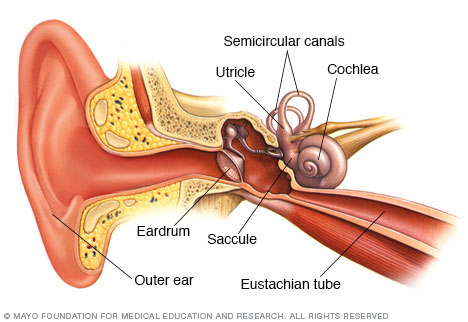
The exact cause of Meniere's disease isn't known. But researchers think symptoms are related to a buildup of fluid, called endolymph fluid, in the inner ear. The fluid buildup is called endolymphatic hydrops. It's not clear why this fluid builds up.
Issues that may cause fluid buildup include:
- Poor fluid drainage. This may be due to a blockage or the shape of the ear.
- Autoimmune diseases, such as rheumatoid arthritis and lupus. These conditions happen when the immune system mistakenly attacks the body's own healthy tissues.
- Viral infections.
- A family history of this condition.
But it's not clear if a fluid buildup causes symptoms of Meniere's disease or just happens alongside them. It's likely that the disease is caused by a combination of factors.
Risk factors
Meniere's disease is most common in people between the ages of 40 and 60.
Your risk may be higher if:
- You have a close family member with Meniere's disease.
- You have an autoimmune condition.
Complications
The most challenging complications of Meniere's disease include:
- Sudden and unpredictable vertigo attacks.
- Possible long-term hearing loss.
Because symptoms can happen without warning, the condition may lead to worry, stress and anxiety.
Vertigo also can cause you to lose your balance. This raises your risk of falling and getting injured.
Diagnosis
To diagnose Meniere's disease, your healthcare professional asks about your health history and does a physical exam.
A diagnosis typically is based on the following:
- At least two vertigo attacks that each last between 20 minutes and 12 hours. Rarely, a vertigo attack lasts up to 24 hours.
- Hearing loss confirmed by a hearing test.
- Ringing in the ear or a feeling of fullness or pressure in the ear.
Meniere's disease shares symptoms with other conditions. Your healthcare professional may do tests to rule out other possible causes of your symptoms.
Hearing test
A hearing test is called audiometry. Audiometry checks how well you hear sounds at different pitches and volumes. It also tests how well you can tell the difference between words that sound the same. People with Meniere's disease often have trouble hearing low-pitched sounds or a mix of high and low pitches. But they may have typical hearing in the midrange.
Balance tests
Most people with Meniere's disease regain balance between vertigo attacks. But some people have lasting balance issues.
Your healthcare professional may use the following tests to see how your inner ear and balance system work:
- Electronystagmography (ENG) or videonystagmography (VNG) tests. These tests measure balance by tracking how your eyes move. One part follows how your eyes move with a target. Another part checks eye movement as your head changes positions. A third part, called the caloric test, uses warm and cold air or water in the ear to see how your inner ear reacts.
- Rotary chair test. You sit in a computer-controlled chair that gently spins. Eye movement is recorded to check how your inner ear responds.
- Vestibular evoked myogenic potentials (VEMP) test. This test uses sound to make parts of the inner ear active. It records how well your inner ear muscles respond. It may show common changes seen in people with Meniere's disease.
- Computerized dynamic posturography (CDP). During this test, you stand barefoot on a platform while wearing a safety harness. The test changes what you see and feel under your feet. You try to stay balanced while your brain processes the information from your eyes, inner ear and body. This helps your care team understand which part of your balance system may need help.
- Video head impulse test (vHIT). This test measures how well your eyes and inner ears work together. vHIT uses video to measure eye reactions to sudden movement. While you focus on a target, your head is moved quickly. If your eyes don't stay on the target, it may show an issue with your balance reflexes.
- Electrocochleography (ECoG). This test measures how your inner ear responds to sound. It may help detect inner ear fluid buildup.
Tests to rule out other conditions
Your healthcare professional may use lab tests, imaging scans and other tests to rule out conditions that may cause symptoms like those of Meniere's disease. Other conditions that may cause similar symptoms include a brain tumor and multiple sclerosis.
Treatment
There is no cure for Meniere's disease. But some treatments may lessen how often you have vertigo and how serious the episodes are. Unfortunately, there are no treatments to reverse long-lasting hearing loss. But your care team may suggest ways to protect your remaining hearing.
Medicines for vertigo
Your healthcare professional may prescribe medicines to take during a vertigo attack to help ease symptoms.
- Motion sickness medicines. Medicines such as meclizine (Antivert) or diazepam (Valium) may lessen the spinning feeling and help with nausea and vomiting.
- Anti-nausea medicines. Medicines such as promethazine also may help lessen nausea and vomiting.
- Diuretics and betahistine. These medicines can be used together or alone to improve vertigo. Diuretics help remove extra fluid in the body, which may lower the amount of pressure in the inner ear. Betahistines ease vertigo symptoms by improving blood flow in the inner ear.
Long-term medicine use
Your healthcare professional may prescribe medicine to reduce the amount of fluid your body stores. And they may advise you to limit your salt intake. This may help control the frequency and seriousness of Meniere's disease symptoms for some people.
Noninvasive therapies and procedures
Some people with Meniere's disease may benefit from treatments that don't include surgery, such as:
- Vestibular rehabilitation therapy (VRT). This is a form of therapy that helps improve balance between vertigo attacks. VRT helps retrain the brain to use other senses, such as vision and body awareness, to improve balance.
- Hearing aids. A hearing aid in the ear affected by Meniere's disease may improve your hearing. Your healthcare professional can refer you to a doctor who specializes in hearing, called an audiologist, to find the right hearing aid.
If these treatments aren't successful, your care team may suggest other options.
Middle ear injections
Medicines injected and absorbed in the middle ear may help vertigo symptoms get better. A healthcare professional does this treatment in their office. Injections may include:
- Gentamicin. This is an antibiotic that damages the part of the inner ear causing vertigo. This allows the healthy ear to take over balance functions. But it may cause more hearing loss in the affected ear.
- Steroids. Steroids such as dexamethasone may reduce vertigo attacks in some people. Dexamethasone may not work as well as gentamicin. But it's less likely to cause further hearing loss.
Surgery
If vertigo attacks from Meniere's disease are serious and other treatments haven't helped, your healthcare professional may suggest surgery. Surgeries include:
- Endolymphatic sac surgery. This surgery lessens pressure in the part of the inner ear that manages fluid levels. Sometimes, a tube is placed to help drain extra fluid.
- Labyrinthectomy. In this procedure, a surgeon removes the part of the inner ear that causes vertigo. It causes complete hearing loss in that ear, so it's only done when hearing is already very poor or lost. The healthy ear takes over balance and hearing functions.
- Vestibular nerve section. In this procedure, a surgeon cuts the vestibular nerve, which sends balance information from the inner ear to the brain. This typically stops vertigo while saving hearing in the affected ear. It's done using medicine that puts you to sleep, called general anesthesia. If you have this surgery, you'll need to stay overnight in the hospital.
Lifestyle and home remedies
Some symptoms of Meniere's disease may be easier to manage with self-care. Try these tips during a vertigo attack:
- Sit or lie down as soon as you feel dizzy. Avoid anything that can make your symptoms worse. These activities may be sudden movements, bright lights, watching TV or reading. Try to focus on something that isn't moving.
- Rest during and after the attack. Don't force yourself to return to your everyday activities. If you feel tired, lie down and rest for a short time. When you feel ready, slowly get up and move around. Gentle movement helps your brain reset your sense of balance.
- Plan ahead. Talk to your healthcare professional about how you can prepare for vertigo attacks. Ask what medicines you can take to ease symptoms and when to seek medical help. Also ask about ways to prevent injury, such as how to lessen your risk of falling.
Lifestyle changes
Making a few healthy lifestyle changes may help prevent vertigo attacks.
- Limit salt. Too much salt can cause your body to keep extra fluid, which may trigger symptoms. For good health, aim for less than 2,300 milligrams of sodium a day. It also helps to spread your salt intake evenly throughout the day instead of eating a lot of salty food at once.
- Limit caffeine, alcohol and tobacco. These can trigger vertigo attacks in some people. Try keeping a journal of your symptoms and note what may be causing them.
Coping and support
Meniere's disease can affect your daily life, relationships and overall well-being. Learning more about your condition can help you feel more in control.
Consider joining a support group to connect with others who understand what you're going through. Support groups can offer helpful tips, emotional support and information about living with Meniere's disease. Ask your healthcare professional about local groups or check online resources such as the Vestibular Disorders Association.
Preparing for an appointment
You'll likely start by seeing your regular healthcare professional. They may refer you to a doctor who is an ear, nose and throat specialist, called an ENT. Or they may refer you to a hearing specialist, called an audiologist, or a nervous system specialist, called a neurologist.
Here are some tips to help you get ready for your appointment.
What you can do
When you schedule your visit, ask if there's anything you need to do ahead of time, such as not eat or drink before a test. Bring a family member or friend with you if you can. They can help you remember all the information you're given.
Write down the following:
- Your symptoms, especially what happens during a vertigo attack, how long the symptoms last and how often they happen.
- Key personal details, such as recent stress, big life changes and family medical history.
- All medicines, vitamins and supplements you take, including names, doses and how often you take them.
- Questions to ask your healthcare professional.
For Meniere's disease, some good questions to ask your healthcare professional include:
- What's likely causing my symptoms?
- Could anything else be causing these symptoms?
- What tests do I need?
- Is this condition likely short-term or lifelong?
- What treatments do you recommend?
- Are there other treatment options?
- How should I manage this along with my other health conditions?
- Are there activity or diet restrictions I should follow?
- Should I see a specialist?
- Are there handouts or websites you recommend?
Don't wait to ask other questions that come to mind during your visit.
What to expect from your doctor
Be ready to answer questions such as:
- When did your symptoms start?
- How often do they happen?
- How serious are your symptoms and how long do they last?
- What, if anything, seems to trigger your symptoms?
- What, if anything, seems to improve your symptoms?
- What, if anything, appears to worsen your symptoms?
- Have you had ear problems before? Does anyone in your family have ear or balance issues?
© 1998-2026 Mayo Foundation for Medical Education and Research (MFMER). All rights reserved. Terms of Use