


Overview
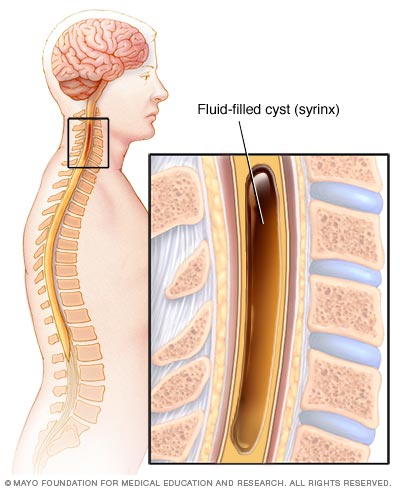
Syringomyelia (sih-ring-go-my-E-lee-uh) happens when a fluid-filled cyst develops within the spinal cord. The cyst, which is sometimes called a syrinx, can grow larger over time. When it does, it can damage the spinal cord and cause pain, weakness, stiffness or loss of feeling.
Syringomyelia has several possible causes. Most seem to affect the way fluid flows around the spinal cord and brain. When this fluid doesn't flow as it should, it may lead to the condition. Syringomyelia is often connected with Chiari malformation. This is a condition in which brain tissue pushes into the spinal canal.
Other causes of syringomyelia include spinal cord tumors, spinal cord injuries, and damage caused by swelling or scarring around the spinal cord. Sometimes the cause of syringomyelia isn't known.
If syringomyelia doesn't cause issues, monitoring might be all that you need. But if the symptoms are bothersome, you might need surgery.
Symptoms
Syringomyelia symptoms usually happen slowly over time. Although both adults and children can have syringomyelia, symptoms tend to begin between ages 25 and 40.
In some people, coughing or straining can trigger symptoms of syringomyelia, although neither causes syringomyelia.
Syringomyelia symptoms often are felt in a capelike pattern across the neck, back, shoulders, arms and hands. If the syrinx extends lower in the spine, you may feel symptoms in the lower body. If the syrinx extends upward toward the brain, you may feel symptoms in the face.
Symptoms of syringomyelia include:
- Pain in the neck, arms and back.
- Loss of sensitivity to pain and temperature.
- Headache.
Other symptoms affect the muscles, joints and movement, including:
- Loss of reflexes.
- Stiffness in the back, shoulders, arms and legs.
- Loss of feeling or movement in the face.
- Muscle weakness and muscle wasting.
- Loss of grip strength.
- Scoliosis, a condition in which the spine curves sideways.
Syringomyelia symptoms that may change basic functions of the body include:
- Trouble breathing, especially during sleep.
- Changes in bladder, bowel or sexual function.
When to see a doctor
If you have any of the symptoms of syringomyelia, see your healthcare professional.
If you've had a spinal cord injury, watch for symptoms of syringomyelia. It may be months to years after an injury before syringomyelia happens. Make sure your healthcare professional knows about a spinal cord injury you've had.
Causes
It's not clear how or why syringomyelia happens. Most studies show a connection between the condition and how fluid pulses and flows around the brain and spinal cord. This fluid is called cerebrospinal fluid (CSF). CSF surrounds, cushions and protects the brain and spinal cord. When the CSF is blocked in any way, it may not pulse and flow as it should. This may cause the fluid to build up within the spinal cord itself. If the buildup forms a fluid-filled cyst, it is called a syrinx.
Many conditions may affect the flow of CSF and cause a syrinx to form. There are different types of syringomyelia linked to these conditions. They include:
- Chiari-related syringomyelia. This also may be called congenital syringomyelia or communicating syringomyelia. Chiari-related syringomyelia is the most common form of the condition. Many adults and children with Chiari malformation develop syringomyelia.
- Primary spinal syringomyelia. This also may be called acquired syringomyelia or noncommunicating syringomyelia. In this type, the flow of CSF may be affected due to an underlying issue with the spinal cord. Issues may include having a tethered spinal cord, trauma, tumors, swelling or scarring of the membrane that covers the spinal cord. This membrane is called the arachnoid. Thickened areas of swelling or scarring on this membrane are called arachnoid adhesions. They may form after surgery or illnesses such as meningitis.
- Posttraumatic syringomyelia. This type is caused by severe injury to the spine or spinal cord.
- Idiopathic syringomyelia. In this type, it's not clear what causes the syrinx to form. Tests may not show any clear signs of what could be affecting the flow of CSF.
Complications
Some people may never have symptoms of syringomyelia. But for others, syringomyelia can cause symptoms that get worse. If a syrinx grows and damages nerves within the spinal cord, it can lead to serious complications.
Complications include:
- Scoliosis. The spine may curve sideways if nerve damage weakens certain muscles that support the spine.
- Joint deformity. The joints of the shoulders, elbows or hands may change shape as their muscles weaken from nerve damage. A joint that changes shape like this is called a Charcot joint.
- Chronic pain. Nerve damage may cause ongoing feelings of burning, tingling, numbness or pain that feels like an electric shock.
- Numbness and sensory loss. Parts of the body may feel numb or not able to sense pain or changes in temperature. Often, this happens in a capelike pattern along the neck, shoulders and upper arms. If a syrinx extends upward, it may cause numbness in the face. If it extends downward, it may cause numbness in the lower body.
- Motor difficulties. The legs may feel stiff and weak. It may be hard to walk or stay balanced. Reflexes may be slow, or muscles may contract on their own. Also, it may be difficult to move the face, mouth or tongue.
- Changes in digestive, bladder, bowel or sexual function. If a syrinx grows and extends lower, it may impact these functions of the lower body. Digestive complications may include upset stomach, vomiting, and appetite and weight loss.
- Paralysis. In severe syringomyelia, total loss of movement or feeling in the face or one or more limbs is possible.
Diagnosis
Your healthcare professional asks about your medical history and does a complete physical exam. In some cases, syringomyelia might be found during a spine MRI or CT scan done for other reasons.
If your healthcare professional suspects you may have syringomyelia, you may need to undergo testing. Tests may include:
- MRI. An MRI scan of the spine and spinal cord is the most reliable tool for diagnosing syringomyelia.
An MRI uses radio waves and a strong magnetic field to produce detailed images of the spine and spinal cord. If a syrinx has developed within the spinal cord, it is visible on the MRI scan. You may have a special kind of MRI called a cine MRI. Cine MRIs create short videos of processes within the body by taking many pictures very quickly. These videos are useful to assess the pulse and flow of the cerebrospinal fluid.
The MRI might be repeated over time to find out whether syringomyelia is getting worse.
- CT scan. A CT scan uses a series of X-rays to create a detailed view of the spine and spinal cord. It can help find tumors or other spine conditions.
Treatment
Treatment for syringomyelia depends on how bad the symptoms are and the size of the syrinx.
Monitoring
If syringomyelia isn't causing symptoms, it may not need treatment. But the condition should be carefully monitored to be sure it doesn't get worse. Your healthcare professional may check it from time to time with MRI and neurological exams.
Medicines
Your healthcare team may prescribe medicines to help relieve symptoms caused by syringomyelia. Although these medicines won't cure the condition, they may help manage pain and motor function. Some medicines have shown promising results in small studies, but more research is needed to support more widespread use.
Medicines that may help relieve pain include:
- Nonsteroidal anti-inflammatory medicines (NSAIDs). NSAIDs called COX-2 inhibitors may be used. An example is meloxicam. This type of NSAID is available by prescription only.
- Antiseizure medicines. These include gabapentin (Neurontin, Gralise) and pregabalin (Lyrica).
- Corticosteroids. Prednisolone or methylprednisolone may be prescribed.
- Opioids. Methadone may be prescribed.
Medicines that may help manage motor function include:
- Muscle relaxants such as baclofen (Gablofen, Fleqsuvy, others), tizanidine, clonidine, dantrolene and benzodiazepines.
- OnabotulinumtoxinA (Botox).
Medicines that may help regulate cerebrospinal fluid include:
- Diuretics, such as furosemide.
- Proton pump inhibitors (PPIs), such as omeprazole.
- Carbonic anhydrase inhibitors, such as acetazolamide.
Supportive therapies
Certain therapies are key to managing the symptoms of syringomyelia before or after surgery. Supportive therapies include:
- Physical therapy. A physical therapist can create an exercise program that may help reduce pain and improve muscle function.
- Occupational therapy. An occupational therapist can help you function better in your daily tasks.
Lifestyle and home remedies
The following steps might help you manage the symptoms of syringomyelia.
Avoid activities that can make symptoms worse
Avoid activities that involve heavy lifting, straining or putting force on the spine.
Manage chronic pain
If you have chronic pain from syringomyelia, talk with your healthcare team about treatment options. Many medical centers have doctors who specialize in pain management.
Methods and techniques to relieve pain may include:
- Applying heat or cold.
- Relaxation training.
- Mindfulness and meditation techniques.
- Music therapy.
- Cognitive therapy.
Coping and support
Living with syringomyelia and its complications can be hard. Having someone to talk with — a friend, counselor or therapist — can be helpful. Or you might find the support and encouragement you need in a syringomyelia support group.
Ask your healthcare professional to recommend a local group or look for groups online. A support group provides a place for sharing experiences. It also can be a good source of information and help you get tips for living with syringomyelia.
Preparing for an appointment
You're likely to start by seeing your family healthcare professional. You might get a referral to a neurologist. A neurologist is a doctor trained in brain and nervous system conditions.
Here's some information to help you get ready for your appointment.
What you can do
When you make the appointment, ask if there's anything you need to do in advance. If you have past medical reports or the results of MRI or CT scans that might relate to your condition, bring them to your appointment.
Take a family member or friend to your appointment, if possible, to help you remember the information you receive.
Make a list of:
- Symptoms. Note when they began.
- Medical history. Include spinal or back surgeries you've had and family history of syringomyelia.
- Medicines. List all medicines you take as well as vitamins and supplements. Include dosage information.
- Questions. Having a list of questions can help you make the most of your time with your healthcare professional.
For syringomyelia, questions to ask your healthcare professional include:
- What is the likely cause of my symptoms or condition?
- Are there other possible causes?
- Could my symptoms get better on their own?
- What tests do I need?
- What is the best course of action?
- Can exercise help?
- I have other health conditions. How can I best manage them together?
- Are there brochures or other printed material I can take with me? What websites do you recommend?
What to expect from your doctor
Your healthcare professional is likely to ask you questions, including:
- Have your symptoms been ongoing, or do they come and go?
- How bad are your symptoms?
- What, if anything, seems to improve your symptoms?
- What, if anything, seems to worsen your symptoms?
What you can do in the meantime
Avoid doing anything that worsens your symptoms. For many people with syringomyelia, heavy lifting and straining can trigger symptoms, so avoid these activities. Also avoid flexing your neck.
© 1998-2026 Mayo Foundation for Medical Education and Research (MFMER). All rights reserved. Terms of Use